The Trumpets and Drums in the Forest on the Shores of Lake Saaka Made the Laudato Si’ Green Festival in Fort Portal Very Memorable
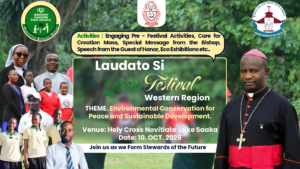
Laudato Si Voices | First Laudato Si Green Festival | Fort-Portal Diocese | 24/10/2026
More than 700 young people, explore the beauty of creation, the rhythm of African drums, and a shared commitment to climate action that turned the shores of Lake Saaka a natural cathedral for prayer, to listen to the voices of young people, learn the language of eco-culture, eco-religious tourism, trade skills, love and for one another and Gods Creation while preserving our cultural religious values as young people.
When Nature Became Our Church
When we set out for our first Laudato Si’ Green Festival in Fort Portal, something in our hearts told us that we were going to experience something extraordinary. We did not know exactly how the day would unfold, but there was a sense of excitement, hope, and anticipation among us. We were heading to Lake Saaka, a beautiful place where the green vegetation embraces the water, bells call people to prayer, birds sing freely among the trees, and the surrounding forest seems to tell its own story of life.
The morning was somewhat chilly when we arrived on the shores of the lake. The air was fresh, the landscape was green, and the birds were already singing their morning songs. The gentle beauty of the environment, with the fragrance of flowers, welcomed us in a way that no human words could fully describe. It was as though creation itself had prepared a special welcome for the Laudato Si’ Green Festival.
A gaze at the clean waters of Lake Saaka
For a moment, we could not help but appreciate the simple things we often overlook: the sound of birds, the movement of leaves in the breeze, the calmness of the water, and the freshness of the air. These were not merely beautiful things to look at or listen to. They were reminders of the precious gift of life and the responsibility we share to protect it. If you have ever visited Saaka craters, you will know what we are talking about. This is the place that contains most of the amazing crater lakes of Tooro that the book “40 Amazing Crater Lakes to Visit in Tooro Before You Die” talks about. It is a narrative and pictorial celebration of the most magnificent lakes found in the picturesque Tooro region of Western Uganda.
The book “40 Amazing Crater Lakes to Visit in Tooro Before You Die” by Monica Rubombora, Abooki Alfred Bwomezi, and Apuuli Gwayaka Magelah
The authors (natives of the land), Monica Rubombora, Abooki Alfred Bwomezi, and Apuuli Gwayaka Magelah, tell us that Millions of years ago, a gigantic crack formed in the middle of the African Continent, now known as the “Great East African Rift Valley.” Volcanic eruptions created fascinating land features and one of the world’s densest concentrations of amazing, mesmerizing lakes.
Pope Francis, in his encyclical Laudato Si’: On Care for Our Common Home, reminds us that the Earth is our common home and that everything in creation is interconnected. We cannot separate our relationship with God from our relationship with the natural world or from our responsibility toward other people.
At Lake Saaka, this teaching became more than something we had read in a document or heard in a classroom. It became an experience. We could see, hear, feel, and appreciate the beauty we had gathered to protect at the beginning of the day. Our team of Laudato Youth Initiative leaders set up the venue, ready to receive the visitors.
Setting up the venue for the Laudato Si Green Festival at Holy Cross Noviatiate Lake Saaka
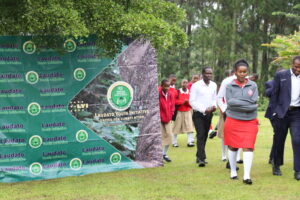
The forest was our classroom. The Saaka Lake shore was our meeting place. The birds were among our first choirs. St. Maria Goretti Girls, the birds nested in red and white, crossed the River Mpanga, the source of life for our people in the region, to come and animate the day’s care for creation Mass. Nyakasura School is close to the Mabere Caves and Hakigere Historical and Ecological Sites, and other young people from our Laudato Si Clubs and the different communities were ready to learn, celebrate, and renew their commitment to caring for our common home.
Some Laudato Si Club members begin to arrive and join in for the preparation of the venue
The Fishermen Who Taught Us a Lesson Without Saying Much
One of the most beautiful encounters of the morning was with the fishermen along the shores of Lake Saaka. As we walked around the lake, we met men going about their daily activities. They passed by us with naturally beautiful smiles, seemingly at home in the cool morning air.
They were bare-chested, while some of us felt the cold and wished for warmer clothing. For them, however, this was a familiar environment. They had grown up in the area, lived close to the lake, and fed on the fish of the lake, so it was stranger to them, and over time they have developed a relationship with the surrounding landscape that many of us visitors could only begin to understand.
Their smiles communicated something powerful: belonging.
For generations, local communities have depended on their natural surroundings for food, livelihoods, identity, and a sense of home. Their daily lives remind us that environmental protection is not simply about saving trees, keeping water clean, or planting flowers. It is also about protecting the places where people live, work, raise their families, and find meaning. The place we each of us call home! This was a big lesson for us. What is that place I call home? And what has been my role in protecting it, preserving it, and its beauty?
The fishermen reminded us that local communities must be at the heart of environmental conservation. Those who know a place intimately often understand its changing seasons, the behaviour of its waters, the importance of its vegetation, and the challenges facing its resources.
Their experience is valuable knowledge.
At the same time, caring for a lake requires collective responsibility. Communities need support to protect water quality, manage waste, conserve surrounding vegetation, and promote fishing practices that allow fish populations to recover and thrive. Environmental programmes become more meaningful when they listen to local people rather than treating them merely as beneficiaries.
That morning, the fishermen did not need to deliver speeches to teach us. Their presence alone challenged us to ask ourselves an important question: How can we claim to love nature if we fail to appreciate the people whose lives are closely connected to it?
The Laudato Si’ Green Festival was not only about bringing young people to admire a beautiful landscape. It was also about helping us recognise the people who live within that landscape and the dignity of their relationship with creation.
Trumpets and Drums: When the Forest Found Its Voice
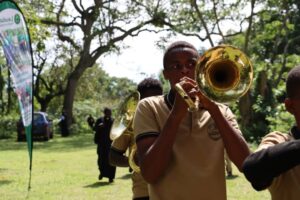
As the festival unfolded, the sounds of trumpets and drums became part of the story of Lake Saaka. We deliberately chose music that would animate the gathering without overwhelming the natural atmosphere. We wanted to celebrate, but we also wanted to listen. We wanted to make music without forgetting the birds, the trees, the water, and the quiet beauty that had welcomed us. This matters today: many people go to quiet places for festivities, only to destroy nature, litter the environment, and cause sound pollution that threatens the ecosystem. Will this help you rethink how you prepare your future event?
The trumpet in the forest heard with echoes at the Western Region Laudato Si Green Festival in Fort- Portal
The drums were not merely instruments of entertainment. They carried a message.
In many African communities, drums have traditionally served as instruments of communication, celebration, welcome, unity, and communal identity. Their rhythms can announce important gatherings, accompany ceremonies, bring people together in dance, and communicate emotions that ordinary speech sometimes struggles to express.
Drums invited people to listen to the call of nature
At Saaka, the drums became a bridge between culture and environmental awareness. Their rhythms invited people to draw closer, while the melodious voices of the young people carried the message of the Laudato Si’ Voices to the grassroots in the language they understand. That’s our African way of bringing Laudato Si to life and interpreting it to grassroots communities that can neither read nor write.
We wanted the community to hear us, but more importantly, to understand us.
The sound of the drums was a call to awaken our environmental conscience. It was a reminder that the Earth is not an object to be exploited without limits but a gift entrusted to our care. Every beat carried an invitation: protect the trees, respect the lake, care for the soil, reduce pollution, and remember the generations that will come after us. Bishop Robert Muhirwa Akiiki went on to urge young people to distance themselves from the habit of consumerism and adopt simple morally grounded lifestyles while respecting their cultures and family roots. He used St. Francis of Assisi as an example.
The Laudato Youth Initiative is devoted to the patronage of Saint Adolf Tibewalirwa, also known as Ludigo Mukasa, one of the 45 Catholic Uganda Martyrs whose pilgrimage site in Katoosa is being upgraded for faith-based tourism to preserve his memory while strengthening an eco-environment for prayer, reflection, spiritual pilgrimage and sustainable conservation that can lead to socio-economic transformation. The site is being gazetted under the Uganda Museums and Monuments Act as a protected historical and religious landmark. This gives us hope that our patron of herdsmen and farmers’ legacy will stand as strong as that of St. Francis of Assisi. For Many of us, St. Adolf is the St. Francis of Uganda. And the festival in Fort Portal Diocese has much to teach us about the strength of protecting the source of the life of our people and the land that feeds us.
Our Patron Saint Adolf Tibewalirwa, also known as Ludigo Mukasa, and for us we call him the St. Francis of Uganda, this image shows you what he stood for
King Oyo Nyimba Kabamba Iguru Rukidi IV just passed on, and he left a powerful message. In his 2022 historic expedition to the summit of the Rwenzori Mountains (Mountains of the Moon), the highest point in Uganda. The hike was a childhood dream meant to draw attention to Uganda’s greatest natural treasures, and especially to raise our awareness of the threat climate change poses to its glaciers and the wider ecosystem that depends on these mountains.
In this beautiful documentary, the King told the story himself. He spoke of the Rwenzori Mountains as a source of life, of the people and communities whose lives depend on the waters that flow from these mountains, and of our responsibility to protect this treasure for those who will come after us. This is a strong inspiration our young people in the Laudato Si Club will keep pondering and emulating. They care for their motherland and for creation in a unique way.
We have seen from experience that the trumpets added their own brightness to the celebration.
Their sound traveled across the gathering, giving the festival a spirit of joy and hope. Together, the instruments created a powerful expression of African identity and Christian commitment. Yet the most important music was not the music of the instruments alone. It was the music of a community coming together around a shared purpose. We did not want to bring noise into the forest and call it environmental awareness. We wanted to use music as a language of love, a language that could gather people around the beauty of creation and encourage them to protect it. That is what made the trumpets and drums so memorable. They helped turn a message about the environment into something people could feel in their hearts.
The trumpets in the forest calling for ecological conversion
More Than 700 Young People United for Climate Action
The shores of Lake Saaka became a meeting point for more than 700 young people who came together for this faith-inspired environmental festival. Young people from Fort Portal, Kyenjojo, Kamwenge, and participating schools and communities gathered with a common desire to celebrate creation and discover how they could contribute to a greener future, reflecting on the theme of the day, “Environmental for Peace and Sustainable Development”
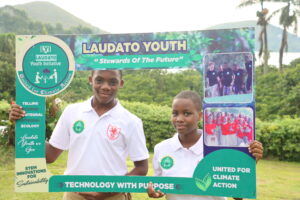
Our motto, “United for Climate Action,” captured the spirit of the day.
Climate change is a global challenge, but its effects are experienced in local places and in ordinary lives. Changes in rainfall patterns, prolonged dry spells, floods, soil erosion, declining soil fertility, and pressure on water resources can affect farming families, fishing communities, schools, and entire local economies. Uganda, where many livelihoods depend on rain-fed agriculture and natural resources, has strong reasons to invest in environmental education and practical climate action.
Young people have a particularly important role to play. They will live with the consequences of decisions being made today, but they are also capable of shaping better choices in their schools, families, parishes, communities, and future workplaces.
The Laudato Si’ Green Festival offered a space where young people could move beyond the feeling that climate change is too large a problem for one person to address.
One student can organise a school clean-up. A group of young people can establish and care for a tree nursery. A parish can reduce disposable plastics at its events. A school can collect rainwater, protect its gardens, compost organic waste, or teach students how to maintain indigenous trees. A community can organise regular lake-shore clean-ups and encourage responsible waste disposal. Universities can train students in eco careers so what we teach in Laudato Si clubs becomes skill trades for future sustainability. Our Laudato Youth Initiative Executive Director, Mr. Benard Kahwa, encouraged youth to rethink handwork skills and innovations that foster sustainability, promote their culture, and could earn them a living, encouraging them to become job creators.
These actions may appear small, but their value grows when they are sustained, shared, and multiplied.
A tree planted and cared for today may provide shade, protect soil, support biodiversity, and store carbon as it grows. A wetland protected from encroachment can help regulate water flows and provide habitat for wildlife. A clean lake supports the people and ecosystems that depend on it. A young person who learns to value these things can influence an entire family or community. This is the kind of transformation we hoped the festival would inspire: young people who return home not merely with photographs and happy memories, but with a new sense of responsibility.
United for Climate Action means that none of us has to do everything alone. It means that each of us can do something, and that together our efforts can become a powerful force for change.
A Festival Enriched by Faith and the Presence of Church Leaders
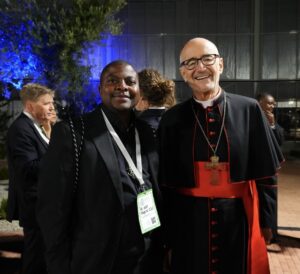
The spiritual dimension of the festival gave the gathering an even stronger meaning. We were honoured by the presence of Bishop Robert Muhiirwa Akiiki, the Bishop of Fort Portal Diocese, alongside many priests and religious, major seminarians and minor seminarians. Their presence reminded us that caring for creation is not an activity separate from Christian faith. It is an expression of our responsibility to the Creator and our love for our neighbours.
The Book of Genesis presents humanity with the responsibility to cultivate and care for the garden. This biblical calling is not a license to destroy or dominate creation recklessly. It is a responsibility to serve as faithful stewards of the gifts entrusted to us. The festival also promoted the teaching of Pope Francis in Laudato Si’, published in 2015, which calls for an integral ecology: an understanding that environmental, social, economic, and spiritual concerns are connected themes.
We cannot adequately care for the environment while ignoring people living in poverty. We cannot speak about development without considering the health of our soil, water, forests, and air. Nor can we claim to build a hopeful future if we leave younger generations with damaged ecosystems and fewer opportunities. The participation of Church leaders and seminarians helped strengthen this message. Their presence showed that ecological responsibility belongs in our prayers, our liturgies, our formation programmes, and our daily choices.
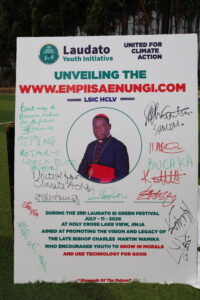
The festival was also graced by visitors from different institutions, including a delegation from the Fort Portal City leadership (Hon. Linda Irene, Woman Member of Parliament, Fort Portal City), who represented the Minister of Tourism as chief guest, a representative of Caritas Kampala, and the Bishop Charles Martin Wamika family, who amplified his moral legacy (www.empiisaenungi.com program) among others. Their participation affirmed the importance of working together across communities and institutions to advance the shared goal of caring for our common home.
Such collaboration matters. Environmental challenges do not respect institutional boundaries, and their solutions require people with different gifts, responsibilities, and experiences to work together.
What we learnt is that
Faith communities can mobilise volunteers, provide spaces for environmental education, promote responsible lifestyles, and encourage leaders to make decisions that protect people and nature. Schools can nurture environmental knowledge. Local authorities can support waste management and sustainable planning. Civil society organisations can provide expertise and help communities organise practical initiatives. When these efforts come together, environmental action becomes more than a slogan. It becomes a shared mission.
A Liturgy That Felt Like Nature Itself Was Praying
The Laudato Si’ Club of St. Maria Gorretti, our host, played a central role in animating the liturgy. St. Mary’s Minor Seminary, together with the Laudato Si’ Club of Nyakasura School, contributed to the liturgical dances, adding movement, colour, and cultural expression to the celebration.
The liturgy felt natural and alive.
There was something deeply fitting about celebrating the Eucharist in a place where the beauty of creation was so visible. The surrounding greenery, the birdsong, the presence of the lake, the rhythm of the drums, and the voices of the young people seemed to remind us that creation itself is a gift worthy of gratitude.
St. Maria Goretti Girls School Laudato Si Club led the gathering in a dance that brought joy and hope
The dances were not simply performances placed between parts of a religious celebration. They helped express a spirituality rooted in the land, in community, and in the rich cultural traditions through which people communicate joy, reverence, and belonging.
Every movement, every voice, and every beat seemed to carry a message of thanksgiving.
The Eucharist also offered an important reminder that the natural world should never be taken for granted. Food comes from the soil, water sustains life, and the materials we use come from the gifts of creation. Our lives depend on relationships with the Earth that are often hidden behind modern conveniences. When we give thanks, we also learn to receive responsibly. When we celebrate the gifts of creation, we are challenged to protect them. And when we gather around the same table, we are reminded that our common home belongs not only to the people living today but also to future generations.
The festival showed how faith, culture, and environmental awareness can reinforce one another. Rather than treating environmental conservation as a subject reserved for science lessons or government campaigns, we can make it part of our worship, our traditions, and our community celebrations. This is one of the beautiful possibilities of the Laudato Si’ Green Festival: helping people discover that caring for creation can be both a spiritual commitment and a joyful communal experience.
Saaka: A Living Classroom in Community Conservation
Lake Saaka was more than a beautiful setting for our event. It was one of our most important teachers. Said the Laudato Youth Initiative Clubs President – Ms. Sarah Kirikumwino, We were socked wet but yet remained joyful.
Ms. Sarah at the Laudato Si Green Festival that was partly gifted with Rain that brought to life childhood memories of playing in rain but just want to be children who enjoy nature’s gift
The area is cherished for its lush vegetation, green surroundings, and natural beauty. Its landscape reminded us of the value of protecting the places that sustain our communities and give them their identity. The care that local communities have given their surroundings over the years offers an important lesson in grassroots conservation. Environmental protection becomes more sustainable when people understand the value of the places around them, participate in decisions affecting those places, and see the benefits of protecting natural resources.
Trees, for example, do far more than make a landscape beautiful. Their roots help hold soil together, reducing erosion. Their canopies provide shade and habitat for birds and other wildlife. Trees can help store carbon as they grow, while appropriately chosen native species can support local biodiversity. Vegetation along streams and lake shores can also help reduce the movement of sediment into water.
These benefits depend on how trees are planted, where they grow, and whether they survive. That is why environmental action must go beyond taking photographs of newly planted seedlings. The real achievement is to care for them, water them when necessary, protect them from damage, and monitor their growth.
The same principle applies to lakes and other water bodies. Protecting a lake requires responsible waste disposal, appropriate sanitation, protection of surrounding vegetation, and cooperation among the people who depend on it. Plastic waste, untreated wastewater, and excessive sediment can damage aquatic ecosystems and threaten the health and livelihoods of nearby communities.
For a festival committed to environmental awareness, Lake Saaka provided a practical opportunity to discuss these issues in a setting where their importance could be seen and appreciated.
It also reminded us that local communities are not merely people waiting for environmental projects to arrive. They are potential leaders, knowledge holders, and partners in protecting the environment. A meaningful environmental programme must therefore ask local people what they know, what challenges they face, what has worked in the past, and what support they need to continue protecting their surroundings. Saaka taught us that conservation begins with respect: respect for nature, respect for local knowledge, and respect for the people whose lives are connected to the land and water.
When the Rain Joined the Celebration
As if the beautiful surroundings, the music, the liturgy, and the gathering of young people were not enough, nature had one more surprise waiting for us. Immediately after Mass, a heavy downpour soaked us.
The rain arrived with such force that the festival took on an entirely new character. Those who had been celebrating in the open suddenly found themselves negotiating the weather, seeking shelter, laughing, and trying to make sense of the unexpected turn of events. Then came a memorable local expression from a native of Saaka:
“Tulima enjura negwa.” The expression was explained to us as meaning that in Saaka, people dig when it is raining.
It was a wonderful moment of local wisdom and humour. The saying gave us a glimpse into a community whose daily life is closely connected to the rhythms of the weather and the demands of the land. For people who depend on agriculture, rain is not merely an inconvenience or a reason to interrupt an outdoor event. It can be essential to planting, crop growth, and the continuation of life. At the same time, the timing and intensity of rainfall matter enormously. Too little rain can threaten harvests, while intense rainfall can contribute to erosion, flooding, and the loss of valuable topsoil.
The experience was a timely reminder of how closely human life is tied to the natural world. We can prepare programmes, organise transport, arrange liturgies, and plan activities, but we cannot command the weather. The rain interrupted our plans, but it also gave us another story to carry home. It reminded us that environmental education need not always happen through formal speeches. Sometimes it happens through an unexpected shower, a local expression, a shared laugh, and the willingness to learn from the people around us.
That downpour became part of the festival’s memory. Long after the instruments had fallen silent, we would remember the rain, the laughter, and the wisdom contained in a few simple words. And perhaps that was another lesson from Saaka: we must learn not only to speak about nature but also to live attentively within it.
From Celebration to Action: What the Festival Asked of Us
A festival can inspire people for a day. A successful environmental movement must help that inspiration become a habit.
This is why the Laudato Si’ Green Festival placed importance on teamwork, prayer, the celebration of eco-culture, reflection on environmental tourism, tree planting, and take-home activities.
Each activity of the Laudato Si Green Festival was designed to serve a purpose.
Teamwork showed that practical change for ecological conversion requires cooperation. Prayer (Care for Creation Mass) connected environmental responsibility with faith and gratitude. Eco-culture celebrated the positive traditions through which communities express their relationship with creation. Reflection on environmental tourism encouraged participants to consider how natural beauty can be appreciated and protected without damaging the ecosystems and communities that make it valuable. Tree planting offered a visible expression of hope, while take-home activities invited young people to continue the work beyond the festival.
All Clubs Carried away with trees – Laudato Si Club member at Mountains of the Moon University with his Tree
The challenge now is to turn these experiences into practical commitments.
A school that participated in the festival could establish an environmental club or strengthen an existing one. Students could organise a waste audit to discover how much rubbish their school produces and identify ways to reduce it. They could separate recyclable materials where suitable collection systems exist, compost organic waste, establish a vegetable garden, or plant appropriate native trees and assign students to care for them.
A parish could make its celebrations more environmentally responsible by reducing single-use plastics, providing clearly marked waste collection points, and encouraging reusable materials. It could include prayers for creation in its liturgical life and organise regular community activities focused on environmental stewardship.
Young people could work with local leaders to identify polluted areas, organise clean-up campaigns, and raise awareness about the importance of protecting wetlands, lakes, and streams. Where communities depend on natural resources for their livelihoods, youth groups could help promote practical conservation measures developed in consultation with local residents.
Tree planting deserves particular attention. It is an excellent activity when it is planned well, but the number of seedlings planted is not the only measure of success. The more important question is how many survive and grow. Choosing suitable species, planting at the right time, protecting seedlings, and assigning responsibility for their care are essential steps.
Participants can also measure progress through simple records: the number of trees surviving after six or twelve months, the amount of waste collected or avoided, the number of students participating in environmental activities, and the number of households reached by awareness campaigns.
These small measures can help schools and communities see what is working and where they need to improve.
Most importantly, every participant can begin at home. Turning off unnecessary lights, avoiding littering, using water responsibly, reducing waste, caring for trees, and encouraging others to protect the environment are practical expressions of the values celebrated at Saaka.
The goal is not to make every young person an environmental expert overnight. It is to nurture a generation that understands its responsibility and is willing to act consistently. The festival was a beginning, not an ending. The Promise of Environmental Tourism. The beauty of Lake Saaka also opened our eyes to the relationship between environmental conservation and tourism.
Uganda is internationally known for its extraordinary natural heritage, including its lakes, forests, mountains, wetlands, and wildlife. These natural assets contribute to the country’s identity and can create opportunities for tourism, employment, education, and community development.
Yet the value of environmental tourism depends on the quality of the environment being visited and the way tourism is managed.
A beautiful lakeshore can attract visitors, but poorly managed tourism can also generate plastic waste, disturb wildlife, put pressure on water resources, and damage vegetation. Responsible tourism must therefore consider the needs of local communities and the long-term health of the places people come to enjoy. At Saaka, the festival encouraged us to imagine a future in which visitors could appreciate the natural beauty of the area while supporting its protection and the well-being of the people who call it home.
Such an approach could include organised nature walks, environmental learning activities, local cultural experiences, community-led clean-up campaigns, and opportunities for visitors to learn about conservation. Any such initiatives would need to be developed in consultation with the community, with proper attention to environmental safeguards, local priorities, and the capacity of the site to accommodate religious activities tourism and a place to pray and find God in Nature. What the world lacks today is good places for silence and meditation near some cities that are more noisy and too busy.
Young people can contribute by becoming environmental educators, responsible tourism advocates, and ambassadors for their communities. They can help visitors understand why littering is harmful, why native vegetation matters, and why local people deserve to benefit from the responsible use of their natural heritage. Environmental tourism should never mean exploiting nature simply because it is beautiful. It should mean creating opportunities for people to appreciate that beauty while helping to preserve it. If Lake Saaka’s natural appeal inspires visitors to respect the environment and support local conservation, its beauty can become an opportunity for learning and community development. The most successful visitor is not the one who leaves the biggest footprint but the one who leaves with a deeper appreciation of nature and a stronger commitment to protecting it.
The Laudato Youth Initiative trying to Bringing the Message Home
A few weeks after the festival, as we reflected on the experience, one thing became increasingly clear: the gathering was much more than a one-day event. The Laudato Si’ Green Festival is part of a wider effort to nurture a culture of care for creation through the Laudato Youth Initiative. As a faith-inspired environmental initiative, it seeks to bring young people together around a shared commitment to ecological responsibility, Christian spirituality, and practical action.
The festival’s arrival in Saaka was particularly meaningful because the area is home to the founders of the Laudato Youth Initiative. Returning to this place brought the initiative closer to its roots and created an opportunity to share its message in a landscape that naturally illustrates why environmental protection matters.
There was something deeply symbolic about gathering young people beside the lake, surrounded by the vegetation and communities that had inspired the initiative’s beginnings. It was a reminder that an initaitive committed to caring for our common home must remain connected to the places, people, and experiences that give it meaning.
The experience also offered an opportunity to strengthen the initiative’s wider mission: to encourage young people to become active participants in environmental conservation rather than passive observers of environmental problems.
A initiative like ours grows when participants carry its message beyond the event. A young person inspired at Saaka may return to school and motivate classmates to plant trees. A teacher may help students develop a practical environmental project. A parish may organise a community clean-up. A group of friends may begin discussing waste reduction, water conservation, or the protection of local biodiversity.
These actions may never attract the attention of a large crowd, but they can be the beginnings of lasting change.
The strength of a youth environmental movement is not measured only by the number of people who attend its festivals. It is also measured by the number of people who continue to act when the music has stopped, the crowds have dispersed, and ordinary life has resumed.
The more than 700 young people who gathered at Lake Saaka represented an important opportunity to spread a culture of care across schools, parishes, dioceses, families, and communities.
Our hope is that each participant becomes an ambassador for creation: someone who can explain why the environment matters, encourage others to take practical steps, and demonstrate through personal example that caring for nature is both possible and necessary.
Thank you for reading our article. You can keep up-to-date by reading our Laudato Si Voices Magazine. Just click here