Laudato Si Voices | Adapted from the theme of Uganda’s National Tree Planting Day 2026 | 09 Nov 2026
Uganda’s indigenous trees are part of our cultural identity, ecological heritage and economic potential. For generations, these trees have provided food, medicine, timber, fuelwood, shade and other essential products while supporting biodiversity, protecting water sources and sustaining community livelihoods. Yet, increasing deforestation, land degradation, unsustainable harvesting and climate change threaten this invaluable heritage.
The 2026 National Tree Planting Day theme, “Indigenous Trees: Reclaiming Our Heritage, Powering Green Economies,” presents an important opportunity for young people and Uganda at large to rethink its approach to tree growing, forest conservation and sustainable economic development.

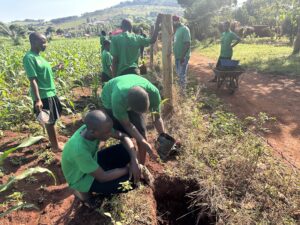
Reclaiming our indigenous tree heritage means recognising the ecological, cultural and economic value of native tree species and deliberately integrating them into national restoration and development programmes. Species such as Mvule, Musizi, Mugavu and Musambya offer opportunities for biodiversity conservation, sustainable timber production, agroforestry, medicinal products and other nature-based enterprises. A year go the Laudato youth Initiative launched a one million tree planting campaign aimed at restoring our forest cover and food security. Young people in our Laudato Si Clubs have dedicated invaluable time on tree planting activities and the national Tree Planting is key for action response.

More importantly, when indigenous trees are adapted to local ecological conditions and, when appropriately selected for particular landscapes, can contribute to ecosystem restoration, soil conservation, water protection and climate resilience. Conserving them also safeguards traditional knowledge and ensures that future generations inherit the natural wealth that defines Uganda.
Beyond environmental conservation, indigenous trees can power Uganda’s green economy. Sustainable forestry, agroforestry, beekeeping, ecotourism, fruit processing, medicinal products and other non-timber forest enterprises offer opportunities for employment, entrepreneurship and household income generation. These opportunities are particularly important for young people in our Laudato Si Clubs, women and grassroots communities, who can participate in tree nurseries, seed collection, planting, forest management, processing and marketing.
However, realising this potential requires deliberate national action. Government should strengthen the implementation of forestry, biodiversity conservation and agroforestry policies, invest in indigenous tree seed systems and support community-based nurseries. Local governments should integrate indigenous tree growing into district development plans, while farmers should be encouraged and supported to incorporate suitable native species into agricultural landscapes. Last year we participated in the National Tree Planting at Mwiri and young people expressed joy to see Uganda rising up with this National Tree Planting project.

We believe the private sector should invest in sustainable forestry and value addition, while financial institutions and development partners should expand access to financing for green enterprises and landscape restoration. Schools, universities, cultural institutions and civil society organisations also have an important role in promoting indigenous tree knowledge, research and environmental stewardship.
Equally important, Uganda must move beyond the culture of ceremonial tree planting towards a sustained culture of tree growing. Success should not be measured simply by the number of seedlings distributed or planted during National Tree Planting Day, but by their survival, growth and contribution to restored landscapes and improved livelihoods. Protecting existing natural forests must remain a priority, as mature indigenous ecosystems cannot easily be replaced. The local communities need to be at the forefront of this project.
National Tree Planting Day 2026 should therefore be a catalyst for collective action. Every household, institution, farmer, business and community should take responsibility for protecting existing trees, planting appropriate indigenous species and nurturing them to maturity.

Ultimately, reclaiming our indigenous trees is an investment in Uganda’s identity, environmental security and economic transformation. Let us move from planting trees for a day to growing forests for generations. Our indigenous trees are our heritage; their sustainable management is our economic opportunity and their conservation is our responsibility.