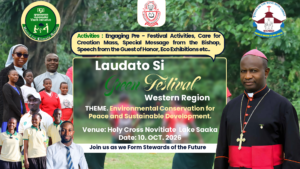
In his homily, at the Laudato Si’ Green Festival in Jinja Fr. Peter Caxton Mayanja, C.S.C., the Congregation of Holy Cross Province of East Africa Provincial Superior said. There Is No Plan B in caring for Our Common Home adding that
Failure to recognize Christ makes humans blind even to the responsibilities that the Creator has given them. Drawing on his personal experiences with storytelling and reading, Fr Mayanja spoke about the importance of storytelling for ecological awareness.
Greeting
My dear friends, once again, I welcome you to this special celebration of the Eucharist, the Green Mass (Mass for the care of Creation), as we make a commitment before God that we are ready to take care of the home He has entrusted to us. In the Congregation of Holy Cross, we have something we call providence. Providence reminds us that things do not simply happen by chance. God is present in creation and continually entrusts us with the responsibility of caring for what He has made.
As we prepared for this Green Festival, New Vision published an article about the anticipated El Niño rains. The article began by recalling a human tragedy familiar to many of us in eastern Uganda, where mudslides caused destruction, displacement and loss of life. What struck me most was the question the writer posed:
How prepared are we for such disasters, and what can we do to prevent similar calamities in the future? That question is at the heart of our celebration today.
Let us not be like Poor Kapere
Some of us may remember the story of a character called Poor Kapere. What made Kapere memorable was the foolishness of his actions. His behavior can be compared to someone sitting on a tree branch while cutting the very branch on which he is sitting. What do we expect to happen? He will fall.
My dear friends, we do not want to be like Poor Kapere.
I use this example because both the first and second readings speak to us about what Scripture calls foolishness. In biblical wisdom literature, foolishness is not simply an insult. It describes a regrettable failure to recognize reality and to act wisely. The first reading speaks beautifully about the beauty of creation. God created the world and everything in it, and creation is a testimony to His wisdom and goodness. Yet the tragedy is that some people can look at this beautiful creation and fail to recognize both its value and its Creator.
When we fail to recognize the Creator, we can also become blind to the responsibility He has given us.
That is why we gather for this Green Mass: to make a commitment that we will not be foolish stewards. We will not destroy the very home upon which our lives depend. Instead, we will do something tangible to make our common home a better place for everyone.
The earth is our only hope while we are are still on this planet and the Future of those coming after us
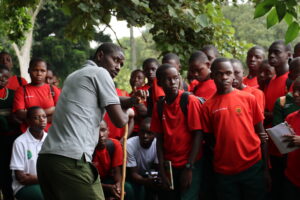
This morning, I was impressed by the messages written on the placards carried by those who participated in the Green Festival walk. Two messages particularly caught my attention. The first said: “The earth is our only hope.” For us in Holy Cross, those words carry a special meaning. Our congregation has long proclaimed that “the cross is our only hope.” To say that the earth is our only hope is to recognize that this planet is the home God has given us.

We sometimes speak about other planets, Jupiter, Mars and others, as though they might provide an escape from the consequences of what we are doing to our own planet. But destroying our environment while imagining that we can simply move somewhere else would be another form of the foolishness Scripture warns us against. The second message on the placards was even more direct: “There is no Plan B.” There is no Plan B because there is no other home to which we can simply run when we have exhausted, polluted or destroyed this one. Plan A is to care for the home God has entrusted to us.
Jesus’ gaze upon creation
In the Gospel, Jesus speaks about serving different masters, but He also directs our attention to creation. Pope Francis, in Laudato Si’, speaks of Jesus’ gaze upon creation, the way Jesus looked attentively at the natural world around Him. This is evident throughout the Gospels. Jesus spoke about birds of the air and flowers of the field. He observed creation and used it to reveal the goodness and providence of God.

Jesus tells us to look at the birds: they do not sow or reap, yet our heavenly Father provides for them. He points us to the flowers of the field and their beauty. If God cares for the birds and clothes the flowers with such beauty, how much more will He care for us? But there is another important lesson here.
God cares for us through His creation.
Therefore, if we want God’s creation to continue sustaining us, we must take care of what He has created. We cannot destroy the forests, pollute our water, degrade our soils and damage our ecosystems and then expect creation to continue providing for us as though nothing has happened.
Our responsibility is therefore both spiritual and practical.
Jesus concludes with a profound invitation: “Seek first the kingdom of God.” When we put God at the center of our lives, our relationship with creation must also change. We begin to see the earth not as something to exploit without limits, but as a gift and a trust.
From hope to action
As we commemorate the anniversary of Pope Francis’ encyclical Laudato Si’: On Care for Our Common Home, we are challenged to move beyond simply saying, “Hope is good.”
Hope must lead to action.
We must ask ourselves: What tangible things are we committed to doing to make our common home better?
Will we plant and protect trees?
Will we reduce pollution and waste?
Will we protect our rivers, wetlands and forests?
Will we use the resources of the earth responsibly?
Will we teach our children to respect and care for creation?
These are not merely environmental questions. They are questions of faith.
God has entrusted creation to us. Caring for it is therefore part of our spiritual responsibility and part of our duty to future generations. The message of this Green Mass is simple: there is no Plan B. This is our home. Let us reject the path of self-destruction. Let us rediscover the beauty of creation. Let us recognize the Creator in the world around us. And, above all, let us translate our faith into concrete action.
May each one of us leave this celebration with a personal commitment to care for our common home. May our schools, families, parishes, institutions and communities become places where environmental stewardship is not merely discussed but practiced. Then, when our earthly journey is complete, may we hear the words of the Lord:
“Well done, good and faithful servant. Now enter into your Master’s joy.”
May God give us the wisdom, courage and commitment to care faithfully for the home He has entrusted to us.
The Lord be with you.
Listen to father Mayanja’s Message to the participants