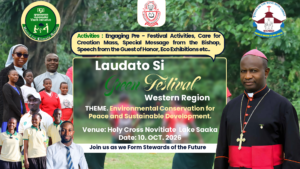
The environment is the foundation upon which all life depends. It provides us with air to breathe, water to drink, food to eat, land for agriculture and settlement, forests for resources, and habitats for countless forms of life. Yet, despite this dependence, humanity continues to place a lot of pressure on the natural world through deforestation, pollution, wetland destruction, irresponsible consumption, soil degradation and activities that contribute to climate change. The environmental crisis is therefore not simply a scientific or economic problem; it is a moral responsibility that concerns every human being.

This understanding is at the heart of Pope Francis’s 2015 encyclical Laudato Si’: On Care for Our Common Home. The document, addressed not only to Catholics but to all people of goodwill, presents the Earth as our common home and calls humanity to a renewed relationship with creation. Pope Francis draws inspiration from Saint Francis of Assisi, who praised God through the beauty of creation and understood the natural world as something worthy of love and protection.
The words Laudato Si’ mean “Praise be to you, my Lord.” They remind us that nature should not be viewed merely as a collection of resources to exploit for economic benefit. The Earth is the home that we share with one another and with other living creatures. Pope Francis warns that irresponsible use and abuse of the Earth’s resources have damaged the soil, water, air and living organisms. This message challenges us to ask an important question: What kind of environment are we leaving behind for those who will come after us?
The Environmental Crisis and Human Responsibility
One of the greatest threats to the environment is deforestation. Trees are cut down for charcoal, firewood, timber, agriculture, settlement and construction. Although forests provide valuable resources, their destruction can result in soil erosion, loss of biodiversity, reduced water availability and increased atmospheric carbon dioxide. Forests also provide habitats for wildlife and contribute to the regulation of the climate.
Environmental conservation requires a change from destructive exploitation to responsible stewardship. Afforestation and reforestation should be encouraged, while illegal logging and uncontrolled charcoal production should be addressed. Communities should be involved in forest management because people are more likely to protect natural resources when they understand their value and benefit from sustainable use.
Pollution presents another serious challenge. Plastics, untreated sewage, industrial chemicals, agricultural chemicals and poorly managed household waste can contaminate land and water. Air pollution from vehicles, industries and burning waste can affect human health and the atmosphere. Rivers, lakes and wetlands that should support life can become dumping grounds.
Laudato Si’ encourages us to recognize that environmental problems are interconnected. The degradation of nature eventually affects human beings, particularly people who depend directly on natural resources for their livelihoods. Pope Francis emphasizes that the environmental crisis and social crisis cannot be treated as separate problems. His vision of integral ecology calls us to consider the relationships between environmental protection, human dignity, society and economic development.

Caring for the Poor and Vulnerable
Environmental conservation is also a question of justice. Poor communities often depend heavily on forests, rivers, wetlands, soils and other natural resources. When these resources are destroyed or degraded, vulnerable people may experience food insecurity, water shortages, displacement and loss of livelihoods.
This is why environmental conservation should not be viewed as something reserved for wealthy countries or environmental organizations. It is a responsibility shared by the whole human family. Development should improve people’s lives without destroying the ecological systems upon which those lives depend.
Pope Francis calls attention to the connection between the cry of the Earth and the cry of the poor. Protecting forests, wetlands, water sources and agricultural land can therefore be understood as protecting human communities as well. Environmental justice requires that development benefits people while respecting the limits of nature.
Climate Change and Sustainable Development
Climate change has made environmental conservation even more urgent. The burning of fossil fuels, deforestation and other human activities contribute to greenhouse-gas emissions and global warming. Climate change can affect rainfall patterns, agriculture, water resources, biodiversity and human settlements.
Laudato Si’ calls for sustainable and integral development and emphasizes the need for collective action. Pope Francis argues that humanity must reconsider lifestyles and patterns of production and consumption that place excessive pressure on the Earth. He also highlights renewable and less-polluting energy, efficient use of resources, sustainable agriculture and better management of forests and other natural resources as important elements of a global response.
Sustainable development therefore means meeting present needs without destroying opportunities for future generations. Economic growth should not be measured only by the amount of goods produced or money earned. It should also consider the quality of people’s lives, the health of ecosystems and the condition of natural resources.
The Role of Individuals and Communities
 Environmental conservation begins with everyday choices. Every individual can contribute by planting trees, avoiding unnecessary waste, conserving water, reducing the use of disposable plastics, protecting water sources, using energy responsibly and keeping the surroundings clean.
Communities can organize environmental clean-up campaigns, protect wetlands and forests, establish tree-planting programs and educate their members about sustainable resource use. Farmers can practice soil conservation through terracing, contour farming, mulching, agroforestry and crop rotation. Such practices can reduce soil erosion while maintaining agricultural productivity.
Schools also have a significant role. Environmental education should not remain in textbooks alone. Learners can participate in tree planting, school gardening, waste separation, environmental clubs and community conservation activities. Such practical experiences can develop responsible attitudes towards nature.
A Change of Heart: Ecological Conversion
Perhaps one of the most powerful messages of Laudato Si’ is that environmental conservation requires more than laws and technology. It requires a change in the way people think and live.
If people see nature only as something to consume, environmental destruction will continue. But if people understand that they are part of creation and that their lives are connected to the lives of others, they can develop a deeper sense of responsibility.
This can be described as ecological conversion a transformation in attitudes, values and behavior that leads people to care for creation. It means moving from excessive consumption to responsible use, from wastefulness to moderation, and from selfishness to solidarity.
Saint Francis of Assisi provides an inspiring example of this attitude. His appreciation of creation was rooted in humility and gratitude. Laudato Si’ invites modern society to rediscover this sense of wonder and responsibility. Nature is not simply an obstacle to development; it is a gift that must be appreciated and protected.
What Can We Do?
The challenge may appear enormous, but meaningful change can begin with simple actions. Governments must enforce environmental laws and promote sustainable development. Businesses should reduce pollution and adopt environmentally responsible production methods. Religious institutions can promote environmental responsibility as part of moral and spiritual formation. Schools can educate young people to become environmental stewards. Communities can protect local ecosystems. Individuals can make responsible choices in their daily lives.
Most importantly, these efforts must work together. Pope Francis stresses that the ecological challenge requires people to come together and seek sustainable development. Because the world is interconnected, environmental problems cannot always be solved by individual countries acting alone.
Conclusion
Environmental conservation is ultimately about protecting the home that humanity shares. The forests, rivers, lakes, wetlands, soils, animals and atmosphere are not merely resources for immediate consumption; they are essential parts of the life-support system upon which present and future generations depend.
Laudato Si’ gives environmental conservation a profound moral dimension. Its message is clear: caring for the Earth is inseparable from caring for humanity. We cannot claim to love our neighbors while destroying the natural systems that sustain their lives. We cannot speak of development while destroying the resources upon which future generations will depend.
The task before humanity is therefore both challenging and hopeful. As Pope Francis reminds us, change is possible, and the protection of our common home requires the participation of everyone.
Let us therefore move from words to action. Let us plant trees where forests have disappeared, protect wetlands before they are destroyed, keep our communities clean, conserve water, reduce pollution and use natural resources responsibly. Let us teach children not only to understand nature but also to love and protect it.
The Earth is our common home. Its future is in our hands. If each person accepts the responsibility to care for creation, our combined actions can build a cleaner, healthier and more sustainable world. In the spirit of Laudato Si’, may we learn once again to say, through our actions as well as our words: Praise be to you, my Lord, through our common home.
The Author
Mr Sabastian Mugisa is a Co Patron of the Laudato Si Club at
St. Maria Goretti Girls Secondary School Fortal -Uganda