Laudato Voices | Jan 04, 2026 | Poverty, Sustainability and Environmental Health
Uganda is a young country facing a defining challenge: how to create economic opportunities for its growing youth population while protecting the environment and safeguarding public health. The connection between sustainability, poverty, and environmental health is therefore not simply a global concern; it is a daily reality for many Ugandans, particularly young people.
According to the 2024 National Population and Housing Census, young people aged 18–30 constitute approximately 23.3% of Uganda’s population, while adolescents aged 10–19 account for 24.9% (Uganda Bureau of Statistics [UBOS], 2024). This youthful population represents both a development challenge and a major opportunity for Uganda’s future.
Poverty, Youth and the Environment
For many young Ugandans, poverty and environmental challenges are closely connected. Limited employment opportunities can push young people towards livelihoods that depend heavily on natural resources, including agriculture, fishing, charcoal production and informal businesses. While these activities provide essential income, unsustainable practices can contribute to deforestation, soil degradation, pollution and biodiversity loss.
At the same time, environmental degradation can deepen poverty. Droughts, floods, declining agricultural productivity and pollution can destroy livelihoods and increase household vulnerability. Uganda’s national income poverty rate declined from 20.3% in 2019/20 to 16.1% in 2023/24, but approximately seven million people remained below the national poverty line (UBOS, 2025). This demonstrates that poverty remains an important barrier to sustainable development.
Environmental Health Is Youth Health
Environmental sustainability must also be understood as a public-health issue. Poor waste management, unsafe water, air pollution, inadequate sanitation and climate-related hazards can negatively affect physical and mental health. These challenges are particularly important in rapidly growing urban areas where young people increasingly live, study and work.
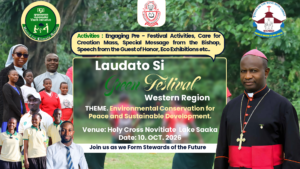
The Laudato Youth Initiative efforts of this year will focus on helping young people define the relationship between poverty, sustainability peace and environmental health, highlighting issues such as air and water pollution, mental health, climate anxiety, resilient food systems, affordable clean water and energy, sustainable towns and cities and Laudato Si Green Festivals that promote ecological conversion
For Laudato Yotu Initiative, these priorities are highly relevant. A healthy environment provides the foundation for young people to learn, work, establish businesses and participate fully in national development.
The Youth as a Solution
Uganda’s youth should not be viewed only as beneficiaries of sustainability programmes. They are among the country’s most important potential drivers of sustainable development. With appropriate skills, financing and opportunities, young people can create businesses and innovations in renewable energy, recycling, sustainable agriculture, waste management, eco-tourism and green technology.
Education and vocational training can play a particularly important role. Equipping young Ugandans with knowledge about climate-smart agriculture, environmental management, engineering and green entrepreneurship can help transform environmental challenges into opportunities for employment and innovation.
This approach reflects the emphasis of the Laudato Youth initiative on the importance of research and science, climate education, agribusiness, engineering, mental health, hygiene health and the humanities to develop safe, just and sustainable communities in Uganda.
Building a Just and Sustainable Uganda
Uganda’s sustainability agenda must ultimately be about people as much as the environment. Economic development that destroys ecosystems cannot be sustained, while environmental protection that ignores poverty is unlikely to succeed.
The country’s large youth population presents an extraordinary opportunity. Investing in youth education, employment, health, empowerment and civic participation can help Uganda realize the benefits of its demographic structure (UBOS, 2024).
The future of Uganda therefore depends on connecting economic opportunity, environmental responsibility and human health. Sustainability should mean creating a Uganda where young people can find dignified livelihoods without being forced to sacrifice the natural resources and healthy environment on which future generations depend. This also would solve the immigration challenge where young people are leaving their home land in search of green pastures while their Country is the Pearl of Africa. This is a missed opportunity and climate education is helping us prepare young people to be creative and learn the value of protecting their homeland.
For Uganda’s youth, sustainability is not simply about protecting the planet. It is about reducing poverty, creating decent livelihoods, protecting health and building a future in which both people and the environment can flourish.
References
Uganda Bureau of Statistics. (2024). National population and housing census 2024: Final report—Volume I (Main). Uganda Bureau of Statistics
Uganda Bureau of Statistics. (2025). Uganda National Household Survey report 2023/2024. Uganda National Household Survey report