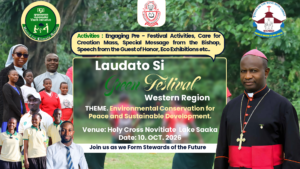
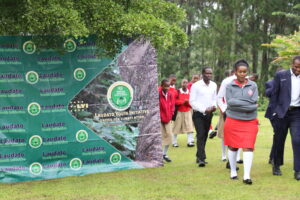
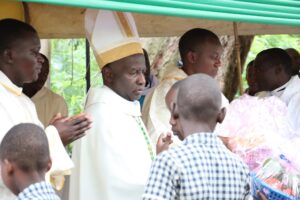
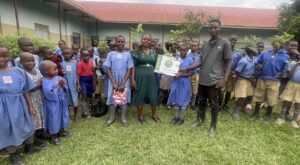
Blending performing arts, music, nature sounds, church architecture, and hand gestures helps us explore creation more deeply and connect with God through Faith, Nature and works of restoration and sustainability.
In approaching Laudato Si (Praise be God) from a cultural and religious perspective, we develop themes that support talent development, faith formation, and mental health, among others, to bring harmony in the world. This year, the church worldwide celebrates the 800th anniversary of the death of Saint Francis of Assisi, and we in Uganda reflect on the life and values of St. Adolf Mukasa Ludigho, a Ugandan martyr who is recognized as the St. Francis of Uganda through his legacy and virtuous life.
The Influence of Performing Arts and Music on the Life of St. Francis of Assisi
On Sunday, 7 May 2026, Prof. Dr. Saju George, SJ, organized a Laudato Si show at Chiesa Di Sant’Ignazio di Loyola, Rome, Italy, an event marking the 800th anniversary of St. Francis of Assisi’s death. The performance featured an Indian Dance-Drama by Fr. Saju George, SJ, and his troupe, who used music, dance, and drama to reflect on St. Francis’s life, and how it continues to inspire us eight centuries after his death.

Reflecting on the performance, Br. Adolf said he was moved by how music, hand gestures, natural sounds, and church music combined to express Laudato Si’s values. Instead of relying only on words, the presentation used movement, gesture, rhythm, sound, and vibrant culture to tell the story. Expressive hands, traditional music, and energetic dance brought the message to life. He stressed the importance of encouraging Laudato Youth to seek real encounters with the living world, which thrives when approached with attentiveness, wonder, and respect, saying, ” We all learned that ‘All the angels pray. Every creature can pray. The birds can be seen lifting themselves to heaven and giving voice to what seems a prayer in the words of Tertullian.

Creative Messaging, Culture, and Communication for Youth Engagement
Continuing his reflection, Br. Adolf said I was especially struck by the effectiveness of the performing arts as a means of communication. Communication is not limited to words; gestures, motions, sounds, and drumming are significant communicative tools. For example, in African culture and for us in Uganda, a single drum stroke can gather people from afar. Recognizing this, Brother Adolf added that emphasizing natural sound to communicate the values of nature is particularly profound from a communications perspective.
Themes like care for creation, respect for life, simplicity, and solidarity with the poor can be conveyed creatively, ensuring the message uplifts. As a computer teacher, he said, over the years, I noticed that young people connect better when messages are engaging and participatory. Thoughtful communication ultimately transforms both mind and heart, and I think this needs to be integrated in communicating the message of Laudato Si because it blends innovation, creativity, gifts, talents, and faith, forming a solid approach to integral ecology, he said.

Leadership and Accompaniment in the Arts
Beyond the performance, I was inspired by Fr. Saju’s humility. As a performing arts professor, he explained his ministry serving humble communities. Through his work in Calcutta, thousands have benefited. Most striking was his leadership and humility in walking with others over the years: rather than directing from the sidelines, he acted, danced, and performed with his team. His example taught a key lesson in accompaniment: true leadership, as shown by Jesus, is walking with others rather than standing above them. It is about sharing the journey, nurturing the talents God gave us, and leading by example, as Jesus did with his disciples. Watching Fr. Saju work with his dedicated professional troupe inspired me to appreciate the value of supporting young people, listening to them, and creating opportunities for their holistic growth, grounded in knowledge of God and the importance of his creation.

For the Laudato Youth Initiative, this experience is both a challenge and a motivation: how can we engage youth creativity, energy, and potential to promote Integral Ecology? Arts and culture to powerfully share Laudato Si’s message and inspire ecological action, because today our common home faces environmental devastation, fragility, isolation caused by technology, abandonment of the poor and orphans, mental health issues, industrialization, ecological imbalance, and loss of heritage. Moreover, the poor are often excluded from community life and programs.
Laudato Si and why we form Laudato Si Clubs
Laudato si’, an Italian phrase that translates to “Praise be to you,” derived from the opening line of St. Francis of Assisi’s 13th-century poem, the Canticle of the Creatures. It is also the name of Pope Francis’s landmark 2015 papal encyclical, subtitled “On Care for Our Common Home”. That inspired us at Laudato Youth Initiative to mentor “Laudato Si Clubs” in Schools, Universities, Parishes, Dioceses, and Communities.
For the Laudato Youth Initiative, this experience is both a challenge and a motivation: how can we engage youth creativity, energy, and potential to promote Integral Ecology? Arts and culture powerfully share Laudato Si’s message and inspire ecological action. However, today we face environmental devastation, fragility, abandonment, mental health issues, industrialization, ecological imbalance, and loss of heritage. Moreover, the poor are often excluded from community life and programs.
St. Francis of Assisi: Inspiration for Our Time
Reflecting on St. Francis of Assisi’s life, we remember why Pope Francis chose him as Laudato Si’s inspiration. St. Francis saw all creation as God’s gift, treating every creature as kin. His life was marked by simplicity, humility, peace, and care for the poor. As our world now faces environmental and social crises, his example speaks with new urgency.

This year, Pope Leo XIV declared a year of grace for the 800th anniversary of St. Francis’s death. This is not just about remembering a saint but living his values. Here in Uganda, we also marked the 62nd anniversary of the Uganda Martyrs’ canonization and our patron, St. Adolf Mukasa Ludigho. Looking ahead, we have opportunities to use the arts to share the values of both saints, making them living messages for our time. All this inspires our commitment to living Laudato Si’ and Integral Ecology – when faith, culture, and creativity unite, hearts are touched, and Laudato Si’s message comes alive, uniting God’s people for real action. Our Laudato Youth will continue enhancing their work, in spiritual growth, showcasing talent in performing arts and music, dance, and Drama, innovative exhibitions, researching on environmental challenges, and devising solutions reflecting on Laudato Si Chapter One “What is happening to our common home?