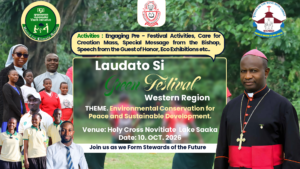
Under the guidance of the Chaplaincy at Mountains of the Moon University (MMU), students have been introduced to the Laudato Youth Initiative. This Catholic youth-led initiative, based in Kampala, which aims to mentor ecologically responsible citizens by establishing Laudato Si Clubs in schools, universities, parishes, and dioceses throughout Uganda and beyond. The initiative unites young people for climate action, encourages hands-on responses to environmental challenges, and promotes ecological and biodiversity-related research and innovation. It also inspires community engagement through service-learning activities that address vital social issues, including support for the impoverished and marginalized, in accordance with the message of Laudato Si, the Millennium Development Goals on ecology and biodiversity, and Catholic social teachings on the environment and human development.
Laudato Si is an encyclical letter authored by Pope Francis, inspired by St. Francis of Assisi’s canticle of creation, “Laudato si mi Signore” (Praise be to you, my Lord), which honors God as the creator. In this encyclical, Pope Francis confronts the environmental crisis and highlights the urgent need for a global response to challenges such as climate change, pollution, and biodiversity loss. He advocates a fundamental shift in humanity’s relationship with the planet, stressing the interconnectedness of all life and the need to care for the Earth as our common home.
According to the Uganda National Population and Housing Census 2024, a remarkable 72.3% of the population is aged 30 and below, amounting to over 33 million individuals out of a total of 45 million. This demographic reality underscores the critical need for youth involvement in initiatives that will shape their future. The Laudato Youth Initiative recognizes this and actively mentors and empowers young people to take an active role in building a sustainable future, encouraging them to care for our shared home. Pope Francis emphasizes future generations’ responsibility in his call for environmental action, urging youth to “become the architects of a more sustainable and equitable world.”
The encyclical particularly underscores the role of education in helping young people understand the environmental crisis and develop a sense of responsibility towards the Earth. The Pope views youth as essential agents of change, acknowledging their capacity for critical thought and passionate action. He encourages them to draw inspiration from the wisdom of previous generations and to harness the power of solidarity and collective action.
As a vibrant member of the Laudato Si Club at MMU, I feel compelled to share one of the most pressing global issues we face today: climate change. This phenomenon is altering weather patterns, impacting ecosystems, and posing significant challenges to biodiversity, food security, and human health. However, this crisis also offers a tremendous opportunity for positive change, especially through youth involvement in environmental conservation and climate action. Our club is actively engaged in initiatives such as tree planting, community outreach, service learning, and charity work. We are also exploring green scientific innovations and research to deepen our understanding and positively impact the community around our university through awareness-raising and action-based community service programs.
As you may know, climate change refers to long-term shifts in temperature, precipitation, and other atmospheric conditions on Earth. Human activities, such as burning fossil fuels, deforestation, and industrial practices, have significantly increased greenhouse gas concentrations in the atmosphere, leading to global warming. The effects of climate change are evident in the communities surrounding our university, and we aspire to lead the journey toward ecological conversion as pilgrims of green hope.
The impacts of climate change in our region and Country are extensive and devastating. Altered weather patterns result in more frequent and severe storms, droughts, and wildfires, disrupting agricultural production and threatening the livelihoods of millions. Elsewhere in the world, Glaciers are melting, polar ice caps are shrinking, and rising sea levels threaten coastal communities worldwide. Additionally, climate change has social and economic consequences, disproportionately affecting vulnerable communities and causing scarcity and displacement through extreme weather events. Therefore, addressing climate change is not merely an environmental issue; it is a matter of social justice.
Mitigating climate change involves reducing greenhouse gas emissions and transitioning to renewable energy sources like wind, solar, and hydroelectric power. A critical part of this mitigation is preserving and restoring ecosystems. Forests, wetlands, and oceans serve as carbon sinks, absorbing significant amounts of carbon dioxide. Our campus sits on the banks of Lake Saaka; this club envisions being at the center of protecting vital ecosystems and promoting reforestation efforts, setting a strong example for communities around the Lake as an essential step toward mitigating the impacts of climate change. We are inviting every young person to discern their role in promoting behavioral change and environmental conservation efforts.
Given that our generation will be among the most affected by climate change, we, as youth, are uniquely positioned to advocate for change and raise awareness. This is a core emphasis of the Laudato Youth Initiative. From organizing community-based activities to participating in international climate summits, Laudato Youth have emerged as a powerful force in fostering corporate social responsibility and engaging in interfaith initiatives that promote unity and action for our sustainable common home. We work closely with authorities to support and implement government policies that protect the environment, ensuring that these initiatives are well communicated and understood within our communities.
Last September, our university’s Laudato Si Club facilitated an online interfaith conference with five universities in Texas to discuss the Season of Creation. Our members have been actively involved in service-learning activities within the community, engaging in conversations about climate justice and poverty alleviation. As we embrace this Jubilee Year of Hope, we are eager to enhance our response to Sustainable Development Goal 13, which focuses on Climate Action. We aim to foster collaborations for peacebuilding and address emerging issues, while also emphasizing the interconnectedness of humans and ecology, mental health, and youth empowerment on campus and in the community.
Through various initiatives, we strive to inspire our peers to take action against climate change. This includes hosting workshops, awareness campaigns, and expanding tree-planting efforts, along with other community initiatives. We firmly believe that every small action, whether it’s reducing waste on campus or advocating for renewable energy policies, can create a ripple effect that leads to significant global change.
Dear reader, we must all recognize that climate change is one of the greatest challenges of our time. However, it also presents a unique opportunity to unite across borders and generations to protect our planet for future generations. As young people, we possess the power to shape the future of environmental conservation and climate action. By understanding the causes and impacts of climate change, advocating for effective mitigation efforts, and promoting sustainable practices, we can lead the way towards a more sustainable world.
Hope alone is not enough; we must actively work for change. The future of our planet rests in our hands, and if we come together as a united force for climate action, we can make a difference. We invite you to learn more about the Laudato Youth Initiative and how you can become involved in making a positive impact on our environment. Visit www.laudato-youthinitiative.org to learn more.
Together, let us be the leaders and changemakers our world needs. Let us embody the spirit of stewardship that Pope Francis calls for in his encyclical and work collaboratively to ensure that our common home is preserved for generations to come.
Murungi Annest
President, Laudato Si Club of MMU
Deputy Prime Minister, MMUTOSA
Aspiring GRC for the Department of Environmental Natural Resources and Tourism
Bachelor of Environmental Sciences, Year 2, Semester 2