By Laudato Voices | 08 Aug 2025 | Laudato Youth Initiative
Uganda’s economy and livelihoods are deeply rooted in agriculture, which employs over 70% of the population and contributes approximately 24% to the national GDP (UBOS, 2021). However, climate change poses significant risks to this critical sector, threatening food security, incomes, and overall economic development. The country is already experiencing increased climate variability, rising temperatures, erratic rainfall patterns, and extreme weather events. In this article we are exloring what is happening to our coomon home by highlighting the link between climate change and agriculture in Uganda, basing on data obtained through, research evidence, and sustainability perspectives our expereince in integrating the message of Laudato Si’ in our African Conceptual frame work, to understand how our Laudato Si Clubs, grassroot communities and our nation can build resilience and promote sustainable development.
Climate Change Trends in Uganda
Uganda has witnessed a 1.3°C rise in temperature since the 1960s, with projections indicating further increases by up to 2.5°C by 2050 (World Bank, 2021). Rainfall patterns have become less predictable, with longer dry spells and more intense rainfall leading to floods. These changes affect both the timing and productivity of agricultural seasons.
According to the Uganda National Climate Change Policy (NCCP), the frequency of extreme weather events, such as floods and droughts, has increased. For example, the Karamoja region has experienced recurrent droughts that have led to widespread crop failure and food insecurity (UNDP Uganda, 2020).
Impacts of Climate Change on Agriculture
Crop Yields
Uganda’s staple crops: maize, beans, coffee, and bananas, are highly sensitive to temperature and precipitation changes. A study by the CGIAR Research Program on Climate Change, Agriculture and Food Security (CCAFS) found that coffee yields may decline by up to 50% by 2050 if current climate trends continue (Jassogne et al., 2013). Bananas, which are a staple for over 70% of Ugandans, are also affected by pests and diseases proliferating due to warming conditions.
Livestock
Climate change impacts pasture availability, water sources, and animal health. Prolonged droughts have led to reduced grazing areas in semi-arid regions like Karamoja and parts of Northern Uganda, impacting pastoralist communities who rely on livestock for survival. This makes the call to action in Laudato Si and SDG2 and 13 eminent.
Soil Degradation
Increased rainfall intensity leads to soil erosion, particularly in hilly regions such as Mount Elgon and the Rwenzori Mountains. Loss of topsoil reduces fertility and undermines long-term agricultural productivity. Our Laudato Si Clubs have been involved in research to find ways of preserving soil health and recently many are taking on climate smart Agriculture that involves use of organic fertilizers, mulching etc as ideal in heelping recover soil health.
Food Security
The combination of reduced yields, post-harvest losses due to erratic weather, and increased pest outbreaks contributes to chronic food insecurity. According to the Integrated Food Security Phase Classification (IPC), over 9 million Ugandans were food insecure in 2023, with climate variability being a major driver (IPC Uganda, 2023).
Laudato Youth Initiative and SDGs
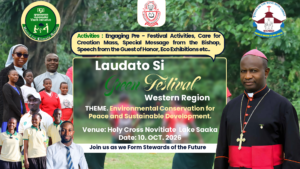
The Laudato Youth Initiative, inspired by Pope Francis’ encyclical Laudato Si’: On Care for Our Common Home, we are taking bold steps in linking environmental sustainability with social justice in Uganda and beyond. Through promoting the notion of integral ecology, in our Laudato Si clubs we encourage communities to adopt sustainable agricultural practices that are both climate-resilient, and culturally adoptable.
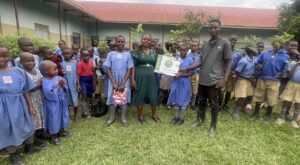
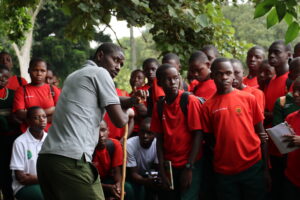
Working through our Laudato Si clubs in schools, universities, parishes, dioceses and grassroot communities we fill the knowledge gap and promote:
• Agroecology and permaculture farming
• Tree planting and reforestation
• Climate education even utilizing the media space
• Water harvesting and conservation
By advancing Sustainable Development Goals such as SDG 2 (Zero Hunger), SDG 13 (Climate Action), and SDG 15 (Life on Land), the Laudato Youth Initiative integrates moral, ecological, and scientific reasoning to promote sustainable agriculture. For example, in St Adolf Holy Cross Parish, the initiative works with samll christian communities.
The SCCs at the parish undertake the following initiatives:
- Care for creation: Members work together to promote environmental sustainability, reduce waste, and protect natural resources. They recognize the importance of preserving God’s creation and take practical steps to reduce their carbon footprint.
- Support vulnerable communities: SCCs reach out to those most affected by environmental degradation, such as the poor and marginalized. They provide support and assistance to those in need, promoting social justice and equality.
- Promote integral ecology: Christians reflect on the interconnectedness of human and environmental well-being, seeking to address social and environmental issues together. They recognize that caring for creation is not just about the environment, but also about the people and communities that depend on it.
Impact
By integrating Laudato Si’ into their lives, SCCs at St Adolf Holy Cross Parish help to:
Deepen their faith: By reflecting on God’s creation and our role as stewards. Members grow in their understanding of God’s love and care for the world.
Build relationships: By working together on environmental and social issues. Members develop strong bonds and a sense of community, working together towards a common goal.
Serve others: By promoting sustainability and supporting vulnerable communities. Members demonstrate their commitment to serving others and promoting social justice.
This has helped to increase smallholder farmers transition to consider climate-smart agriculture techniques that have improved yields and soil health.
Policy and Adaptation Strategies
Uganda has developed several national policies to address the climate-agriculture nexus, including:
• National Adaptation Plan (NAP)
• Nationally Determined Contributions (NDCs) under the Paris Agreement
• Climate Smart Agriculture Program (2017–2026)
These policies emphasize:
• Promotion of drought-resistant crop varieties
• Investment in irrigation infrastructure
• Early warning systems and climate information services
• Capacity building for farmers
However, challenges such as limited funding, inadequate technology transfer, and weak extension services hinder full implementation.
As we reflect on this reality we realise that Climate change presents a formidable challenge to Uganda’s agricultural sector, threatening food security, economic stability, and rural livelihoods. However, through targeted adaptation strategies, investment in climate-smart agriculture, and community-based sustainability initiative like the the work of our Laudato Si Clubs, Uganda has the potential unite its people to build resilience and ensure a more sustainable agricultural future. A concerted effort among government, civil society, religious institutions, and international partners is vital to bridging the gap between vulnerability and resilience. Most significantly is the efforts of the youth shouldnt be left behind because its the only way of investing for the future.
References
CGIAR Research Program on Climate Change, Agriculture and Food Security (CCAFS). (2013). Climate Change Impact on Coffee in Uganda. Retrieved from https://ccafs.cgiar.org
Integrated Food Security Phase Classification (IPC) Uganda. (2023). Uganda Food Security Outlook. Retrieved from https://www.ipcinfo.org
Jassogne, L., B. van Asten, P., & Wanyama, I. (2013). The impact of climate change on coffee in Uganda: Lessons from a case study. CCAFS Working Paper No. 19.
Laudato Youth Initiative. (2024). Annual Report: Integral Ecology in Action
Uganda Bureau of Statistics (UBOS). (2021). Statistical Abstract 2021. Kampala: Government of Uganda. Retrieved from https://www.ubos.org
UNDP Uganda. (2020). Strengthening Climate Information and Early Warning Systems in Uganda. United Nations Development Programme. Retrieved from https://www.ug.undp.org
World Bank. (2021). Climate Risk Country Profile: Uganda. Retrieved from https://climateknowledgeportal.worldbank.org