Laudato Voices | Earth Day is an opportunity to reflect on Climate Education | 22 April, 2026
The reality is that climate education must be taken as a priority discipline in institutions and a norm in our communities. If homes and schools don’t teach about care for Mother Earth, how will they know the science of life and our interdependence and connection with other living things?
Each year, Earth Day returns not merely as a celebration of the planet, but as a measure of our collective responsibility toward it. Our generation is so much defined by the rising concerns about our knowledge of science and faith, best understood through the ecological crisis, rising temperatures, and widening inequalities. People are drifting from matters of faith that identify us with the creator, and with all this, the conversation can no longer remain confined to activism alone. It must move decisively into classrooms, universities, and communities, which are spaces of value formation. That’s why we are saying Climate education is no longer optional; it is foundational.
Recent global developments underscore this urgency. A landmark commitment by the Holy See to place climate education at the center of its environmental policy signals a shift from awareness to institutional responsibility. This decision, welcomed by models such as our Laudato Si clubs and global initiatives such as EARTHDAY.ORG, emphasize that ecological learning must shape not only individual behavior but also entire systems of thought and governance (Vatican News, 2025).
At the heart of this vision lies the transformative concept of integral ecology, first articulated in Laudato Si’. and now profoundly promoted through our action activities. It insists that environmental, social, and spiritual dimensions are inseparable. We also know that climate change is not just a scientific issue; it is ethical, cultural, and deeply human. For this reason, education must move beyond fragmented disciplines and adopt an integrated, values-based approach.
From theory to practice: a living model
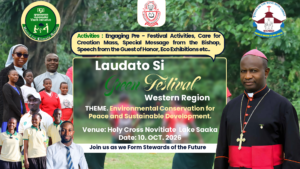
At Laudato Youth Initiative, we see this in a bolder way: inspiring young people to create sustainable solutions for climate change and to embrace scientific models for sustainable agriculture, material waste management, etc. Also, the emergence of the Borgo Laudato Si’ as a center for ecological formation offers a compelling example of what this shift looks like in practice. Conceived as a living and operational hub, it translates the principles of Laudato Si’ into concrete educational experiences, combining sustainability, spirituality, and hands-on learning (Vatican News, 2025).
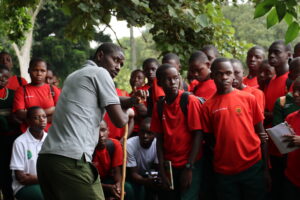
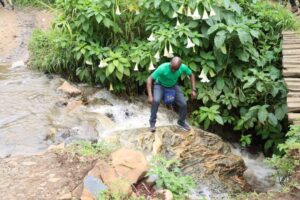
Here we see that education is not confined to lectures or textbooks. It becomes experiential: learning through sustainable agriculture, renewable energy systems, artistic expression, and community engagement. The initiative demonstrates that climate education is most effective when it forms both the mind and the habits of daily life. In Uganda, for example, the new curriculum is a hands-on, competence-based curriculum. It challenges us to engage our young people in creative projects that foster new knowledge and inquiry learning through group tasks and teachers to accompany them. This is true to the Laudato Youth Initiative’s approach to Climate Change. Our Laudato Si Clubs in schools are teaching students inquiry learning, science projects, observational learning, and challenging them to be problem solvers under the guidance of their mentors.
Importantly, Vatican News (2025) reported that such initiatives are not isolated experiments. They are designed to create ripple effects. By embedding ecological education into institutions, schools, universities, and youth programs, they have the potential to influence millions, shaping a generation capable of responding to the climate crisis with competence and conviction.
The role of youth: from participants to protagonists
This is where the work of the Laudato Youth Initiative becomes particularly significant. Young people are no longer passive recipients of environmental education; they are co-creators of it. We nowadays see that youth initiatives are playing a decisive role in advocating for climate education, turning what was once a marginal demand into a global mandate.
The Laudato Youth Initiative advances this shift by nurturing leadership, dialogue, and action among young people. We recognize that education must empower youth not only with knowledge but with agency. Through community projects, advocacy, and Laudato Si Clubs formation programs, young leaders are equipped to translate ecological awareness into tangible change within their own contexts and in their own means, working in close collaboration with their institutions.
This approach reflects a broader truth: the climate crisis is as much a crisis of imagination as it is of policy. Education must therefore cultivate creativity, ethical reflection, and a sense of shared responsibility. Initiatives that engage youth in art, storytelling, and innovation highlight the power of culture in shaping ecological consciousness.
Why institutions must lead
If climate education is to become a priority discipline, institutions must take decisive action. This means integrating sustainability across curricula, not as an isolated subject, but as a lens through which all disciplines are viewed. Economics, theology, science, and politics must all engage with the ecological question.
The precedent is already there. Laudato Si’ has inspired academic programs, research initiatives, and global partnerships across continents, demonstrating that educational transformation is both possible and effective.
However, the scale of the crisis demands more. Institutions must move from symbolic commitments to structural change. This includes investing in teacher training, developing interdisciplinary programs, and creating spaces where theory and practice intersect. It also requires collaboration between governments, faith communities, civil society, and youth initiatives.
Earth Day is an opportunity for us to reflect on integral ecology.
Earth Day serves as a reminder that time is not on our side. The ecological crisis continues to accelerate, and with it, the need for informed and responsible action. Climate education is the bridge between awareness and transformation. Without it, policies lack depth, and activism risks losing direction.
The work of initiatives like our Laudato Youth Initiative shows that when education is rooted in values, community, and action, it can inspire profound change. Form not only environmentally conscious individuals but also leaders capable of shaping a more just and sustainable common home. The young people’s voices need to be heard and supported. They have the energy to get things done, but they need your support to get their ideas to work.
The challenge now is clear: institutions must recognize climate education not as an addition, but as a priority discipline, central to their mission and essential for the future of our common home. Our question remains: has your institution embraced climate education? Are your staff knowledgeable enough to teach young ones about climate change or guide them in their sustainability projects so that we can fight climate change, poverty, and a lack of faith (by promoting reverence for the creator and the value of integral ecology)? Earth Day is an opportunity for us to reflect on integral ecology.
References
Vatican News. (2025, October). Earthday.org: Holy See commitment to climate education has historic value. Retrieved from https://www.vaticannews.va/en/world/news/2025-10/earthday-org-holy-see-climate-education-borgo-laudato-si.html