Laudato Voices | African Congress on Catholic Education| December 4 to 7, 2025
The Laudato Youth Initiative’s model of ecological education, which focuses on the African Interpretation of Laudato Si, was featured at the 2nd African Congress on Catholic Education, held at the Catholic University of Eastern Africa (CUEA) from December 4 to 7, 2025. The event convened leaders in African Catholic education, environmental stewardship, and youth empowerment, highlighting the increasing role of young people in building a sustainable future for the continent.
This event marked significant progress in advancing Laudato Si’s vision of integral ecology and climate education within African Catholic institutions. The Congress offered a platform for dialogue, collaboration, and commitment to fostering environmental awareness among Africa’s youth.
The event that had originally been scheduled for May 2020, but the Covid-19 eventuality forced it to be postponed to 15 October 2020, the very day we our initiative began its mission as an online ministry, when Pope Francis commissioned the Global Compact on Education to revive commitment to and with the younger generations we were inspired by his message and invitation to dialogue on how we are shaping the future of our planet and the need to employ the talents of all, since all change requires an educational process aimed at developing a new universal solidarity”. The uncertainties surrounding the spread of the Coronavirus greatly inspired our approach to Laudato Si, he further emphasized that “we are experiencing an era of change: a transformation that is not only cultural but also anthropological, creating a new semantics while indiscriminately discarding traditional paradigms. Education clashes with what has been called a process of “rapidification” that traps our existence in a whirlwind of high-speed technology and computerization, continually altering our points of reference. As a result, our very identity loses its solidity and our psychological structure dissolves in the face of constant change that “contrasts with the naturally slow pace of biological evolution” (Laudato Si’, 18).
This greatly inspired us to adopt a more varied approach that reflects Pope Francis’ vision for Catholic Education and Laudato Si, where envisioned classrooms as spaces for the transformation of young people and the humanization of society through the cultivation of fraternity among the human family and care for creation where cultures and traditional paradigms are put in consideration, talent and gifts embraced and use of technology for the good is emphasized and modeled and bringing to life the impact of African wisdom of community and unity for action. While commenting on the African Education Pact. Pope said, “he conceived this project under the banner of an African proverb, to “emphasise that community dimension of education that has always been part of your millenary educational tradition: ‘To educate a child, it takes a whole village.'”
In his encyclical Laudato Si, the Pope advocates for environmental education that forms ecological citizenship, which is why we form ‘Laudato Youth’, who contextualize the Pope’s vision into the African Context, leveraging the patroness of African Ecological Integral ecology heroes like St. Adolf Ludigho, a Ugandan martyr and patron of herdsmen and farmers. This strongly aligns with the African Education Pact (AEP), which seeks to advance an education model grounded in Christian and African cultural values. This is exactly what the Laudato Youth Initiative stands for.
Our question is always, what then is the implication of ecological citizenship (EC) on Catholic education, in light of Pope Francis’ vision? Our model clearly examines essential elements that identify Catholic schools, establish their role in seeding ecological citizenship, form Laudato Si Clubs in institutions, churches, and Communities, and inspire other non-Catholic schools to unite for climate action in view of the Ubuntu African Philosophy. More importantly, expound on the implications of Ecological education on the African Education Act to help institutions and churches fulfill their divine mandate of evangelization through programs like the Laudato Si Green Festival, which uses the integral ecology approach to solving ecological challenges, moral and technological advancement issues with regard to our African Cultural values and language.
The Laudato Youth Initiative aims to empower young people to lead climate action in Schools, Parishes, Dioceses, Universities and communities. This vision has taken root from the July Laudato Si Africa Summit in Nairobi, the Laudato Si 10-year Anniversary in Uganda, 10 Years Anniversary of Laudato Si where is Africa and now, as CUEA, Tangaza University College, and Hekima College collaborated to host a four-day assembly. The Congress brought together Church leaders, scholars, educators, and visionaries from Africa and beyond, all dedicated to the African Education Pact, inspired by Pope Francis’ Global Compact on Education and upheld by the Laudato Youth Initiative. This is a big hope for the LYI.
The Congress was especially significant for the Laudato Youth Initiative, as our work was highlighted under the theme ‘Ecology/African Cultural Paradigms in Education.’ Augustine Bahemuka of Hekima University College presented the research paper, “Seeding Ecological Citizenship Among Youth in Africa: Implications of Laudato Si,” showcasing the impact of our programs across the continent.
As delegates from Catholic universities across Africa met to discuss how Catholic schools can become agents of change in today’s world. They addressed pressing challenges, including conflict, climate change, resource exploitation, economic inequality, social injustice, and youth unemployment, reaffirming the Church’s mission to evangelize through action and advocacy.
The presentation outlined strategies for Catholic schools to develop students as ‘ecological citizens’ young people who understand the environmental, social, and cultural impact of their choices and act as responsible stewards of creation.
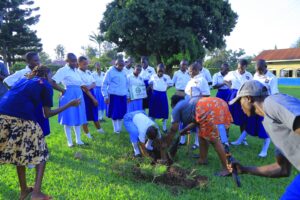
Our experience with Laudato Si Clubs shows that ecological education fosters responsibility and stewardship among youth. As students appreciate the beauty of creation, they develop greater respect for God, their peers, and the environment, laying the groundwork for lasting change.
The conference resolutions confirmed that ecological education and care for our common home are essential for a sustainable future for Africa’s youth. The Laudato Youth Initiative urges the integration of environmental care and sustainability into Catholic education at all levels, including increased awareness of Laudato Si’ and indigenous African ecological traditions. We must restore Africa’s degraded ecosystems for future generations.
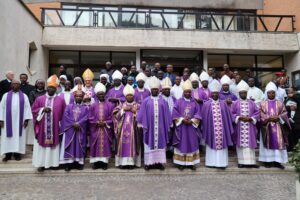
The Congress was graced by the presence of His Eminence Cardinal José Tolentino de Mendonça, Prefect of the Dicastery for Culture & Education, who delivered a message from the Holy Father. African leaders, including Cardinal Fridolin Ambongo and Cardinal Antoine Kambanda, shared theological and cultural insights. Delegates discussed human dignity, fraternity, the common good, ecology (with emphasis on Laudato Si’), and African cultural paradigms in holistic education. The collaboration of CUEA, Tangaza, and Hekima reaffirmed their leadership in Catholic intellectual formation. The Congress concluded with a Mass at Holy Family Basilica, and its outcomes now serve as a blueprint to inspire Catholic education and ecological action across Africa.
In a related development, Pope urges educators in Africa to support youth seeking a better future The congress, titled “Catholic Education and the Promotion of Signs of Hope in the African Context,” focused on revitalising formation grounded in Christ. The Pope expressed appreciation for ongoing efforts to advance the Global Compact on Education, a commitment strongly supported by Pope Francis.
Read the OFFICIAL COMMUNIQUE OF THE SECOND AFRICAN CONGRESS ON CATHOLIC EDUCATION