Laudato Voices | Relevance of the Uganda Martyrs to the Youth Today | Januray 28, 2026
Brief History of the Uganda Martyrs (1885–1887)
The story of the Uganda Martyrs is one of the most powerful testimonies of faith in Africa. Uganda stands out as an icon of faith in the African continent, and every year, between 1 and 3 million people visit the site. The government reported in the Daily Monitor on June 1, 2025, that Namugongo had 690,000 pilgrims for the 2025 Martyrs’ Day.

In 1885 and 1887, a group of young Christian converts in the Kingdom of Buganda were executed on the orders of King Mwanga II because they refused to renounce their Christian faith.
Most of these converts were pages in the royal court and had embraced Christianity through the missionary work of the Society of Missionaries of Africa and Anglican missionaries. Their faith challenged the king’s authority, especially when they rejected immoral practices and refused to obey commands that conflicted with their beliefs.
Among the most prominent of these martyrs were Charles Lwanga, the leader of the young Christian pages, and Kizito, who was only about fourteen years old. On June 3, 1886, many of the martyrs were burned alive at Namugongo Martyrs Shrine. Their heroic witness later led to their canonization by Pope Paul VI in 1964.
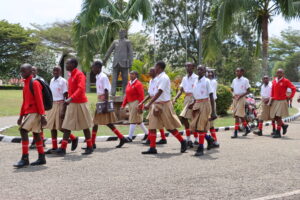
Remarkably, the majority of the Uganda Martyrs were young people, teenagers, and young adults. Their courage and unwavering commitment to their faith make them powerful role models for youth today.
Youthful Courage and Moral Integrity
The Uganda Martyrs are especially relevant to today’s youth because they demonstrate that age is not a barrier to greatness, courage, or holiness. At a time when they faced intense pressure to abandon their beliefs, they chose truth over comfort and conviction over survival.
Figures such as Charles Lwanga protected younger converts and strengthened their faith, even knowing it would cost him his life. Likewise, the young Kizito accepted martyrdom with remarkable joy and bravery.
Their example challenges modern youth to resist negative peer pressure and to live with integrity in a world filled with moral confusion. Like the martyrs, young people today are called to stand firm in their values, remain faithful to truth, and lead others by example.
In a time when many young people struggle to distinguish between modernity and values, define purpose, and moral direction, the Uganda Martyrs show that courage, faith, and sacrifice can transform society.
A Message to the Digital Generation
The relevance of the martyrs has been echoed by many religious leaders, but more remarkably in the Homily of the late Bishop Charles Martin Wamika’s reflection during the 2023 Uganda Martyrs Day at Namugongo, where he prophetically challenged young people to consider the inspiration of the Uganda Martyrs to grow in faith and ponder on how modern life is shaping their values. Addressing pilgrims, he said:
“The youth of today seem more affected by modern life, smartphones, and the internet, and empiisa enungi (good manners) seem to have been thrown overboard. The majority of the Uganda Martyrs were youth like you. When you grow old, how about creating a website: ‘www.empiisaenungi.com’? Dear pilgrims, look around and take note when you get back home. what is it that you will share about the Martyrs? May the Lord increase your faith so that you receive whatever you asked for today.”
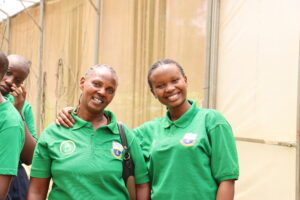
Inspired by this call, the Laudato Youth Initiative, with its Laudato Si Club of Holy Cross Lake View, S.S.S., is developing www.empiisaenungi.com, which symbolizes a new effort to promote good character, moral values, and faith among young people in the digital age, inspired by the Uganda Martyrs. The message is clear: technology itself is not the problem; rather, it should be used responsibly to spread goodness, truth, and virtue.
Just as the Uganda Martyrs transformed their society through faith and courage, today’s youth can transform the digital world by promoting values such as respect, honesty, charity, and responsibility.
The Ecological Legacy of the Martyrs
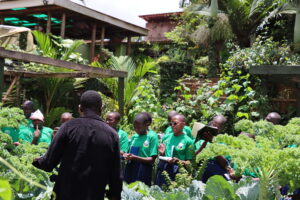
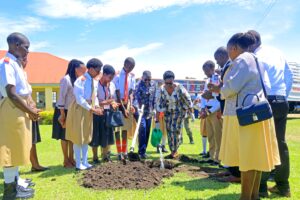
The witness of the Uganda Martyrs also resonates with the growing ecological awareness among young Christians, particularly the Laudato Youth Initiative inspired by Pope Francis and his environmental teaching in Laudato Si’. Many young people in Uganda today identify themselves as “Laudato youth,” committed to caring for creation as part of their faith (Integral Ecology).
One martyr whose legacy speaks strongly to ecological stewardship is Adolf Ludigo Mukasa. Remembered for his humility, discipline, and devotion, he has become an inspiration to farmers and herdsmen seeking to integrate faith with responsible stewardship of the land, as well as to those concerned about sustainability and the conservation of natural resources, and promoting Uganda’s religious tourism and legacy as an agricultural country. This year alone

Young people reflecting on this are learning that being a farmer is a noble profession and that promoting our biodiversity is sacred. His life reflects what today is called integral ecology, a vision that connects faith, social justice, economic well-being, and environmental care. By honoring values such as hard work, community solidarity, and respect for nature, his example encourages young people to see farming, environmental protection, and sustainable livelihoods as sacred responsibilities.
Through this perspective, the Uganda Martyrs are not only spiritual heroes but also guides for social and ecological transformation.
Inspiring Youth to Stand for Truth
Young martyrs like Kizito and Charles Lwanga remind us that holiness is not reserved for the elderly or the powerful. It is often the young who carry the courage to challenge injustice and renew society.
Their lives inspire modern youth to:
• Stand against destructive peer pressure
• Embrace moral virtue and good character
• Remain faithful to their beliefs even in adversity
• Lead with courage and purpose
• Serve their communities with dedication
Their witness proves that young people are not merely the future of the Church and society; they are its present strength.
Seeds of Faith and Hope for Africa
The Uganda Martyrs represent more than a historical event; they are a living seed of faith for Africa and the world. Their sacrifice planted a spiritual legacy that continues to grow across generations.
Their virtues, faith, courage, sacrifice, integrity, and commitment to truth are seeds capable of inspiring a new generation to build societies rooted in justice, charity, and environmental stewardship.
In a world facing social, moral, and ecological challenges, the Uganda Martyrs offer hope. They remind the youth that authentic transformation begins with personal conviction and moral courage.
If young people today follow their example, living with faith, integrity, and responsibility toward creation, they will not only preserve their spiritual heritage but also protect the environment and contribute to sustainable development.
In this way, the witness of the Uganda Martyrs continues to shine as a seed of faith, hope, and integral ecology for Africa and the world.